Bedding · Natural Materials
Dunlop vs. Talalay: Choosing the Right Feel in a Natural Latex Mattress
A latex mattress is not defined by one material alone. Its construction, firmness, layer arrangement and cover all shape the experience. Still, understanding the difference between Dunlop and Talalay latex offers a useful starting point—one that can help turn a dense field of mattress terminology into a more personal, practical choice.
Published October 13, 2026
Natural latex has a particular appeal: responsive rather than sluggish, supportive without necessarily feeling rigid, and available in a range of mattress designs from simple single-core constructions to carefully layered systems. Within that broad category, two names appear frequently: Dunlop and Talalay. They refer to different ways of processing latex, not to a simple ranking of quality.
The distinction matters, but it is only one part of the decision. A mattress’s firmness, the number and placement of its layers, the sleeper’s position and build, the foundation beneath it, and even the quilted cover can all change how it feels. The most useful question is therefore not “Which latex is best?” but “Which construction feels right for me?”
This guide explains how Dunlop and Talalay are made, what their general characteristics may mean in a mattress, and how to compare them with care. It also clarifies an important point for shoppers: “natural latex” and “organic mattress” are not interchangeable labels. Material claims and certifications deserve their own close reading.
First, what is latex in a mattress?
Latex foam is produced by whipping a liquid latex compound into a foam and curing it into a resilient form. The starting material may be natural latex derived from rubber tree sap, synthetic latex, or a blend. A mattress described as natural latex should be assessed by its actual specifications; the phrase alone does not tell you the precise composition of every component, the cover, or the adhesives and other materials that may be present.
Latex is often chosen for its springy response. When pressure is applied, it compresses and then recovers, creating a buoyant sensation that differs from the slower, more enveloping response associated with some memory foams. The degree of contouring and resistance varies by formulation and firmness. Some latex mattresses are made from one substantial core, while others combine several layers with different firmness levels to create a more tailored feel.
For shoppers interested in an organic mattress, the distinction between the foam’s origin and the finished product’s certification is especially important. Ask which components are certified, what standard applies, and whether the certification covers the latex alone or the complete mattress. A natural-material description can be informative, but it is not automatically evidence that every part of a product is certified organic.
How Dunlop latex is made
In the Dunlop process, liquid latex is whipped into foam, poured into a mold, and vulcanized, or cured, with heat. The resulting material is washed and dried. Dunlop is the older of the two widely used latex-foam processes and is common in natural latex mattresses.
Dunlop latex is often described as having a denser, more grounded feel. That description can be a useful shorthand, but it should not be mistaken for a guarantee that every Dunlop mattress is firm. The finished feel depends on the formulation, the foam’s density and firmness, its thickness, and the way it is paired with other layers. A soft Dunlop layer can feel quite different from a firm one.
Because the foam can have a slightly different density distribution through its depth, Dunlop is sometimes characterized as having a more substantial or supportive quality. In practice, shoppers should judge the particular mattress rather than relying on a generalized description of the process. Two products both labeled Dunlop may still feel markedly different.
Dunlop can be appealing to people who like a steadier, more buoyant surface and a less pronounced sense of sinking. It is also used in layered designs, where a firmer core can provide the foundation and a softer upper layer can temper the initial feel. These are possibilities, not rules: construction details are more revealing than the label by itself.
How Talalay latex is made
Talalay begins with a similar foaming stage, but its production includes additional steps. The foam is placed in a mold that is only partly filled; the mold is then sealed, and a vacuum expands the latex to fill it. The material is flash-frozen before being cured, then washed and dried. This sequence creates a different foam structure and a manufacturing process that is more involved than the conventional Dunlop method.
Talalay is often associated with a lighter, more uniform and buoyant feel. Some sleepers experience it as more immediately plush or responsive at the surface. Yet, as with Dunlop, those impressions depend on firmness, thickness, mattress design and the person lying on it. Talalay is available in different firmnesses; it is not inherently soft, nor does its name promise a particular level of pressure relief.
In a layered mattress, Talalay may be used in a comfort layer to offer a lively, spring-like surface, while other latex or support materials form the deeper structure. It can also be used in more substantial configurations. The exact arrangement matters: a thin soft layer over a firm core will not feel the same as a thick, uniformly medium mattress.
There is no universally correct verdict on which process is superior. Talalay’s more uniform feel may appeal to some, while others prefer the denser impression they associate with Dunlop. These are preferences about sensation and construction, not a reliable measure of durability or quality on their own.
Dunlop vs. Talalay at a glance
| Consideration | Dunlop | Talalay |
|---|---|---|
| Production | Foamed, molded, cured, washed and dried. | Foamed and molded, then vacuum-expanded, flash-frozen, cured, washed and dried. |
| Common feel description | Often described as dense, grounded or substantial. | Often described as buoyant, light or more uniform. |
| Firmness possibilities | Available across different firmnesses; construction determines the finished feel. | Also available across different firmnesses; the process does not make every mattress soft. |
| Typical design role | May serve as a support core or as one layer in a layered mattress. | May serve as a comfort layer or be used in other configurations. |
| Best way to compare | Evaluate the complete mattress, including firmness, layer thickness, cover, base compatibility and the return or trial terms. | |
This comparison is a guide to common descriptions, not a promise about how a particular mattress will feel. Manufacturers may use different formulations, and firmness labels are not perfectly standardized across brands. A “medium” in one collection may not match a “medium” elsewhere.
Why firmness and layers may matter more than the latex type
When people compare mattress materials, they can give the name of the foam more weight than the mattress architecture. In reality, a soft comfort layer over a supportive core may feel very different from a single slab of the same latex. The thickness of each layer influences how deeply the body can settle, how quickly the surface responds and how much of the firmer support underneath can be felt.
Firmness is also experienced in context. Body weight, body shape and preferred sleeping position affect how much pressure a sleeper places on the surface. A mattress that feels gently yielding to one person may feel firmer to another. The bed base can contribute, too: a compatible, supportive foundation helps the mattress perform as intended, while an unsuitable or uneven base may alter its feel and support.
Consider the mattress as a complete system. Ask whether it uses one latex type throughout or combines Dunlop and Talalay. Find out how many layers it has, what each layer is designed to do, and whether the manufacturer provides details about firmness or density. If those specifications are unavailable, request them before treating a broad material label as a useful prediction of comfort.
A practical guide by sleeping position
Sleeping position can offer a helpful starting point for evaluating a mattress, though it cannot prescribe one firmness for everyone. The aim is to find a surface that feels comfortable while allowing the body to rest in a natural, supported posture.
- Side sleepers: Pay attention to how the mattress feels around the shoulders and hips. A surface that is too firm for your body may feel uncomfortable at these contact points; a surface that is too soft may not feel supportive. Compare the comfort-layer thickness and firmness, not just whether the latex is Dunlop or Talalay.
- Back sleepers: Look for a balance between cushioning and a stable, supported sensation. The right feel varies with body proportions and preference. Try to notice whether your lower back and hips feel comfortably supported rather than assuming that one latex process will provide a particular alignment.
- Stomach sleepers: Some prefer a firmer, more level surface, but individual needs differ. Consider whether the mattress allows the midsection to settle more than feels comfortable and whether the manufacturer offers a firmness choice or exchange option.
- Combination sleepers: If you change positions through the night, the ease of turning may matter. Latex’s responsive character is often valued by sleepers who prefer a surface that rebounds readily, but the mattress’s overall firmness and layer configuration remain central.
These are comfort considerations, not medical recommendations. If pain or a health condition is shaping your mattress decision, a qualified health professional can offer guidance appropriate to your circumstances.
A real-world example: an all-natural Dunlop construction
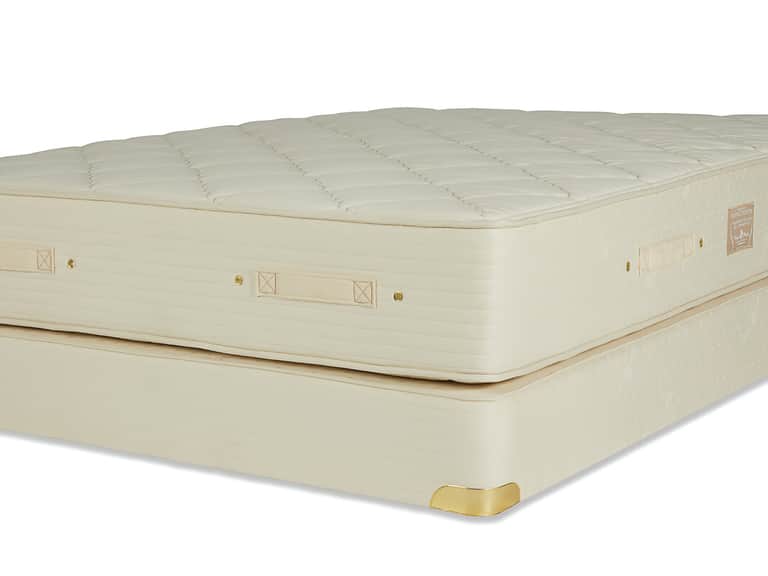
One example of a mattress using Dunlop latex is the Royal-Pedic Natural Latex Quilt-top Mattress with German Stretch Knit ticking. Its listed construction includes an all-natural Dunlop latex core, described as an 8-inch core made up of a 6-inch firm layer and a 2-inch medium layer. The mattress is finished with cotton fabric and chemical-free French wool, according to its product details.
This illustrates why the word “Dunlop” cannot tell the whole story. The example combines latex layers of different stated firmnesses and adds a quilted cover; each element contributes to the overall experience. Its listing also notes that it may be used on an adjustable bed base. Before choosing any mattress, confirm current specifications, available sizes, compatibility requirements and the terms offered by the seller.
The product description identifies the latex as natural, but shoppers seeking a certified organic mattress should verify the relevant certification and exactly which components it covers. Natural origin and organic certification are related questions, not synonymous claims.
Temperature, resilience and durability: what to assess
Latex is often selected for a resilient, open-feeling surface, but temperature comfort depends on more than the foam. Mattress covers, quilting, protectors, sheets, room conditions and the sleeper all have an influence. Wool and cotton, for example, may appear in a mattress cover or quilted layer, but their presence does not make every sleeper feel cool. Look at the complete material stack and consider your own experience with bedding.
Likewise, durability should not be inferred from the Dunlop or Talalay name alone. Ask about the mattress’s materials, construction, care instructions and warranty. The quality and suitability of the support base matter as well. A carefully built mattress can still perform poorly if it is placed on an incompatible foundation or used outside the manufacturer’s requirements.
Latex’s springy response can also influence how motion feels across the bed. Some people appreciate its lively surface; others prefer the more absorbed sensation of a different material. Couples should consider whether they can test the mattress together, particularly if their firmness preferences differ. Split designs or separate comfort layers may offer solutions in some product ranges, but availability varies.
How to shop thoughtfully for an organic mattress
Organic mattress terminology can be complicated because a finished bed contains multiple components: foam, fabric, quilting, fire-barrier materials, thread and sometimes adhesives. A claim about one material does not automatically apply to the whole product. Read the certification language carefully and ask the retailer or manufacturer for documentation when a claim is important to your decision.
- Ask what is certified. Is the certification for the latex, the cover fabric, or the complete mattress?
- Check the precise material description. Clarify whether the latex is natural, synthetic or blended, and whether the description applies to every latex layer.
- Review the full construction. Note the cover, quilting, fire barrier and any additional materials, not only the central latex core.
- Understand the return policy. A trial period can be valuable because showroom impressions and overnight use are not identical. Review conditions, fees and timelines before purchase.
- Confirm foundation requirements. Check whether the mattress is suitable for a platform, slatted frame, box spring or adjustable base, and follow the stated support requirements.
Clear documentation is more meaningful than a string of attractive adjectives. A responsible comparison should help you understand the specific materials and construction rather than suggesting that one label alone guarantees a particular outcome.
A simple decision checklist
Before deciding between Dunlop and Talalay, move through these questions in order. They place the material choice in the context of your actual sleep preferences.
- What sensation do you prefer? Do you like a more substantial, grounded feel, or a buoyant and lively surface? Treat these as broad impressions to test, not fixed properties.
- What firmness feels comfortable? Compare the available firmness options and ask how the manufacturer defines them.
- How is the mattress layered? Find out which latex type appears in each layer, how thick those layers are, and what lies beneath them.
- What position do you sleep in most often? Use it as a clue about where you may want more cushioning or a steadier feel, then account for your body and personal preference.
- Do you need specific material credentials? If organic certification is a priority, verify the precise certification and its scope.
- Can you test or return it? Check the in-home trial, exchange process, delivery details and warranty before committing.
The verdict: choose the feel, then verify the build
Dunlop and Talalay are distinct latex processes with different production methods and commonly described feel profiles. Dunlop is often characterized as denser and more grounded; Talalay is often described as lighter and more uniform. Neither description is a substitute for trying or carefully evaluating the finished mattress. Both types can be made in different firmnesses, and both can appear in a range of constructions.
For a considered purchase, begin with the sensation you like, then examine firmness, layer design, mattress height, cover materials, foundation compatibility and certification details. If possible, test the specific model in the position you usually sleep in and spend enough time to notice pressure and support. When a trial is available, read its terms before ordering.
The right natural latex mattress is not necessarily the one with the most persuasive process name. It is the one whose construction suits your preferences, whose claims are clear, and whose complete materials and support system make sense for your bedroom. That is a more enduring kind of luxury: comfort selected with discernment.